|
|
 |
| Marcus Landslide Virtual Field Trip |
| McDowell Mountain Regional Park, AZ |
|
|
|
|
|
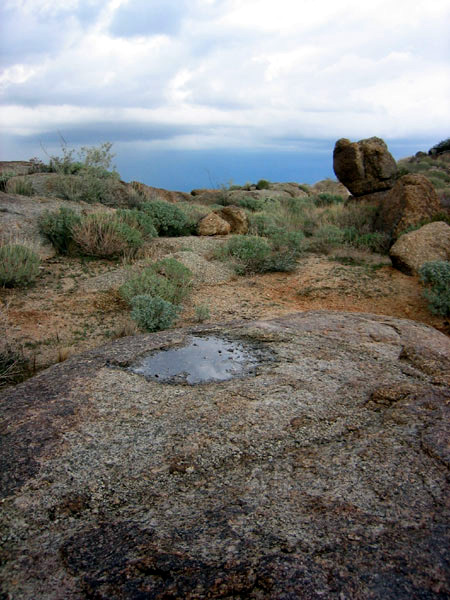
Gnamma Pits - The depression with the small pool of water is termed a gnamma pit. Gnamma pits start with the creation of a small pit, perhaps a centimeter-or-so across. Water that collects in the tiny depression accelerates the decay of the rock's minerals. When the water evaporates and the wind blows away (deflation) the decayed mineral remains, the gnamma pit gets bigger. The bigger pit means that more water collects, weathering even more minerals; with evaporation and deflation of the weathered particles, the gnamma pit grows even bigger. This story goes on and on, with the pit growing in a "positive feedback" until the hole can reach the size of a small swimming pool. The growth stops when the pit gets so big that it breaches the bedrock on the side, and then the water flows freely off the rock — as in this example from the Grand Canyon:
Gnamma pits form in almost all rock types, but they are most common in granitic rock types and sandstone. How
do you
tell the difference between a gnamma pit and metate (place where Native
Americans used to grind plants)? You rub your hand FAST over the
surface. A gnamma pit will rip up your skin, since the weathering
of the individual particles leaves a rough surface. The grinding
slick is so smooth from the rubbing that your hand will appreciate the
smooth surface. |
