|
|
|
| GPH 111 - Intro to Physical Geography |
| Exercise 14 - Tempe Butte |
|
|
|
|
|
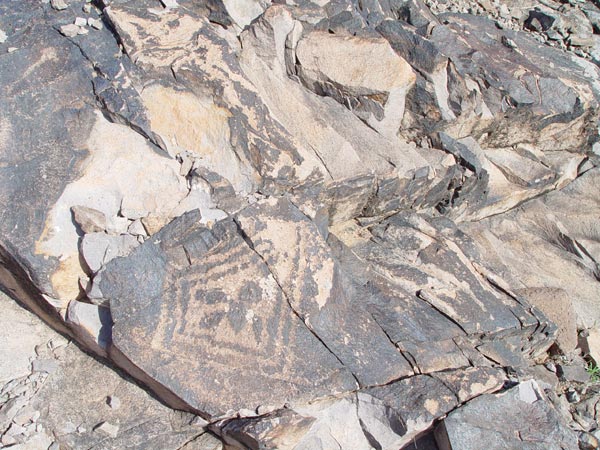
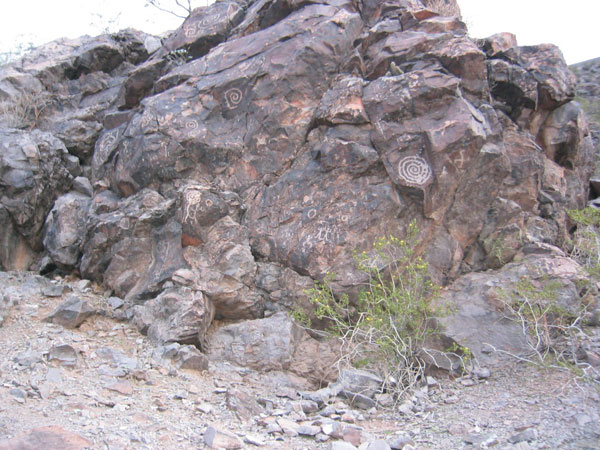
Many rock carvings, or petroglyphs, are found on bedrock outcrops at Tempe Butte. You see the petroglyphs, because they are carved into a natural rock coating called rock varnish. Compare the light gray appearance of andesite with the black color seen on carved rock faces. In a very real way, the rock varnish forms the natural "blackboard' for petroglyphs. When a petroglyph is newly carved, the andesite's light gray color contrasts with the dark brown or black color of rock varnish. But the petroglyph soon starts to varnish all by itself. You can tell "fake-o-glyphs" (recent hoaxes) from real petroglyphs by a careful examination of the carved surface, because real prehistoric petroglyphs will have started to regrow its varnish.
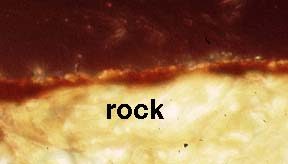
MORE DETAIL ON ROCK VARNISH or NATURE'S PAINT FOR DESERT ROCKS The very dark brown to black color in the varnish comes from the unusually high abundance of manganese (sometimes exceeding 20% in varnish, compared to typical values of 0.1% in dust and rock). The manganese has a black appearance when it is oxidized, as it is in varnish. Manganese is not the only compound in varnish. Petroglyphs in metropolitan Phoenix are revarnished most often with a reddish-coloration. This is also rock varnish, but it has more iron oxides than manganese, giving the new varnish its rusty color. Rock varnish can be used to tell the age of the petroglyphs. Over time, the chemistry of the varnish changes and the details in the layering of the varnish get more complex. Varnishes of three different ages are shown in the picture below, taken of cross sections (very thin slices of the varnish that includes the rock below). This microscope picture shows a very thin (less than 0.01 millimeters) varnish giving the host petroglyph a reddish-brown color.
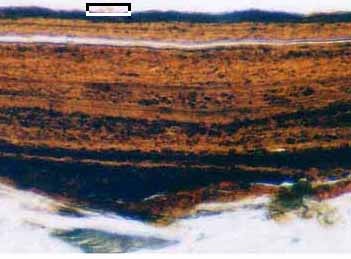
Some of the oldest petroglyphs in the Phoenix area can be seen at the Deer Valley Rock Art Center, run by ASU. The microscope view of varnish below shows the most complex pattern yet seen for a petroglyph on the Phoenix Area. You can see that the surface orange layer has a thin black layer underneath, then a thick orange layer, and then a thick black layer at the bottom. These layers record a sequence of wet (black) and dry (orange) climatic periods at Deer Valley over the past few thousand years. 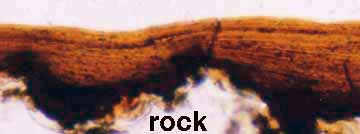
The varnish section
shown below formed on a natural river cobble on a stream terrace of the Salt
River. The varnish was deposited in layers over a period of more than 20,000
years. The rectangle has the same sequence of layering seen on the
Deer Valley petroglyph, and then older varnish underneath records even more
information about climatic change experienced in the Phoenix area.
HOW DOES THIS RELATE TO THE TEMPE BUTTE LABORATORY? Compare the abundance of rock varnish on the south side of Tempe Butte and on the north side of Tempe Butte. The bedrock outcrops on the south side, like those hosting petroglyphs above, have lots of black rock varnish. It takes several hundred to a few thousand years to develop the orange color found within petroglyphs, and more than ten thousand years to form the dark black varnishes seen on natural rock surfaces next to the petroglyphs. What about on the
north side? Remember to look carefully when you visit those stops.
|
NAVIGATION: BACK TO STOP 3