NAVIGATION: BACK TO MODULE TWO INTRODUCTION
Weathering and Erosion
are DIFFERENT!
Before we get
too far along in this
introduction series of introduction Web pages, we need to understand a few basic definitions
and concepts. We need an "introduction to the introduction." First of all, weathering is not weather (for
you geographic information science (GIS) types, just like topology is not
topography)! Sure, the weather
(sunshine, temperature, rain, snow, storms, wind...) does play a HUGE role in weathering - but
the terms have different definitions. Weathering relates to decomposing,
disintegrating, or changing rocks at or near the earth's surface whereas weather
is... well, weather! Again, here's a good definition of weathering:
Simply stated, weathering
is the in-situ (in place) breakdown of material.
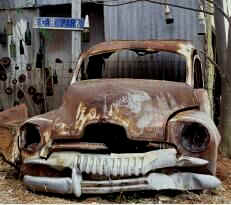 Your
bike chain rusts. Your grandma's birdbath cracks. Newspapers turn
yellow. Names and dates on tombstones become more and more difficult to
read. These are examples of weathering. For this module and the rest
of the course, we're going to ignore your bike chain, your grandma's birdbath,
and even the yellow newspaper. I guess we can NOT ignore the tombstone,
because it is rock, just like the rock (slickrock sandstone surface) in the
image below. We are going to talk exclusively about how ROCK weathers, and
about FORMS produced by weathering processes for the rest of the module.
Your
bike chain rusts. Your grandma's birdbath cracks. Newspapers turn
yellow. Names and dates on tombstones become more and more difficult to
read. These are examples of weathering. For this module and the rest
of the course, we're going to ignore your bike chain, your grandma's birdbath,
and even the yellow newspaper. I guess we can NOT ignore the tombstone,
because it is rock, just like the rock (slickrock sandstone surface) in the
image below. We are going to talk exclusively about how ROCK weathers, and
about FORMS produced by weathering processes for the rest of the module.
Here's
the definition of weathering from a USDA glossary. Weathering "All physical disintegration, chemical
decomposition, and biologically induced changes in rocks or other deposits at or
near the earth's surface by atmospheric or biologic agents or circulating
surface waters with essentially no transport of the altered material. These
changes result in disintegration and decomposition of the material. Compare -
regolith, residuum, saprolite". Notice
how the USDA definition above specifies that there is essentially no
transport of the material?
Weathering,
then, differs from erosion in terms of its lack of ability to move
material! Erosion involves removal (transport) of material away from a site.
There are several erosion transport mechanisms
including wind, water, waves, and gravity.
 This
might help. Imagine
a sandstone tombstone in a Tempe graveyard. If you press the palm of your
hand against the sandstone tombstone, and then pull your hand away and look at your
palm, you will probably see a few grains of sand "stuck" to your
hand. The sand grains stuck on your palm weathered (in place) on the
surface of the tombstone - they had not moved, they were just sitting there,
waiting for some form of energy to come and move them. When your hand inadvertently removed the grains
from the stone, the grains were "eroded".
This
might help. Imagine
a sandstone tombstone in a Tempe graveyard. If you press the palm of your
hand against the sandstone tombstone, and then pull your hand away and look at your
palm, you will probably see a few grains of sand "stuck" to your
hand. The sand grains stuck on your palm weathered (in place) on the
surface of the tombstone - they had not moved, they were just sitting there,
waiting for some form of energy to come and move them. When your hand inadvertently removed the grains
from the stone, the grains were "eroded".
A rock or tombstone
or building or
highway surface "weathers" by breaking down particles
into smaller pieces. Potholes form as particles from the road bed are
removed (erosion) by tires crashing down on the road;
gravity pulls down (erosion) loose rocks from mountain slopes; rain water
becomes concentrated and funneled into channels picking up sediment as it
travels (erosion)... These
"movements" describe erosion. 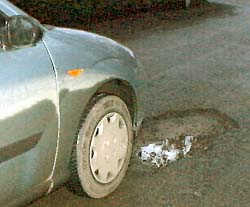
To
summarize, chunks or weathered material (broken up pieces of rock) just sit there in place (in-situ)...
the moment a car tire or running water or gravity or perhaps a strong wind gust
has enough energy to move
or transport the weathered particles, the process becomes erosion.
Erosion is the movement of weathered particles! Simple, right?
The
real challenge of this module is to understand the processes responsible for
"breaking down" the particles in the first place! That is, the
weathering processes! Because weathering and erosion are such good
friends, it is difficult to talk about or teach weathering without mentioning or
referring to erosion too.
|
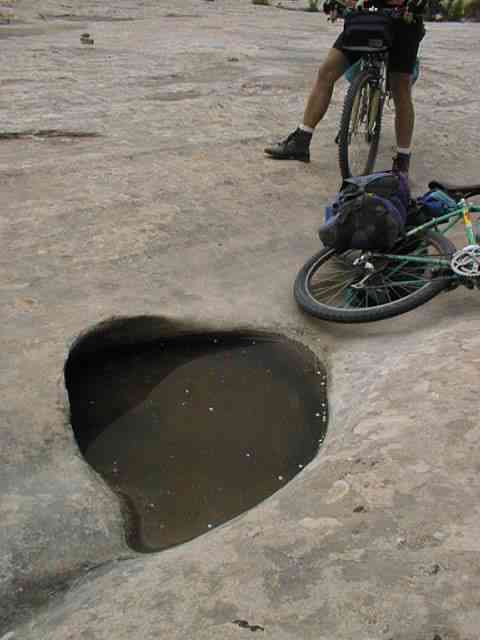
Figure One. Weathering pit/plunge
pool combo. Note 26 inch bike wheel for scale.
|
Here (Figure One above) we
have an interesting form that illustrates weathering AND erosion. The
depression you see above that is filled with water is a combination
"weathering pit" and "pothole". The water trapped
inside the pit accelerates weathering by dissolving the matrix holding the sand
grains together. A positive feedback cycle helps this hole get bigger and
deeper. A positive feedback is a situation where a process enhances
itself. In a weathering pit, the depression itself traps water... the
water, in turn (through weathering) dissolves the rock making the depression
deeper and deeper... So, the deeper the weathering pit, the longer the
water remains trapped in the pit, and the more time the rock is wet, the deeper
the pit.
Material
can be removed from these pits in a couple ways... When the pit is dry,
wind probably scours out the sediment that collects in the pit. During a cloudburst, water probably
runs through this hole (it is located in a topographic low along a drainage) and
flushes out the weathered material (sand). When the material (sand grains)
that are trapped in this depression become "mobile" as they are swept
away by running water or blown away by wind, they are being eroded.