NAVIGATION: BACK TO MODULE TWO INTRODUCTION
Physical Weathering
(some material on this page borrowed from USGS)
Physical
Weathering
The two main types of weathering are physical and
chemical weathering. This page describes mechanical
(physical) weathering (and more).
Rocks are naturally fractured at several levels.
Mineral grains have boundaries, which can be areas of weakness in the rock.
Sedimentary rocks (next time) often are layered and the layers sometimes are not
bound together well. More massive rocks can have joints (cracks which have no
relative motion across them, only spreading) which will open as the rocks are
exposed due to erosion. Physical weathering acts to widen these rock
fractures.
Some examples of physical weathering mechanisms:
-
Frost wedging
Frost wedging happens when water filling a crack freezes and expands (as
it freezes, water expands 8 to 11% in volume over liquid water). The
expanding ice imparts a great amount of pressure against the rock (as much
as 30,000 pounds/square inch) and wedges open the crack. We
see this type of weathering from a distance in the San Francisco Peaks (near
Flagstaff) and up close in the La Sal
Mountains in Southeast Utah (near Moab).
-
Heat/Cold Cycles
As rocks are alternately heated and cooled (that is, as they go through cycles
of hot/cold), they expand and contract;
minerals expand and contract different amounts, and this differential
expansion and contraction may stress rocks and crack them. This is mostly
found in deserts; the actual mechanisms by which it happens are still under
study (Brandon Vogt did his thesis on insolation weathering of sandstone)!
Forest fires (and even lightening!) can crack rocks too! These
hot/cold cycles can occur in a matter of moments (say, as the sun suddenly
passes behind a cloud) or in a matter of hours (diurnal temperature change)
or in the matter of days (air mass behind the passage of a warm/cold
front).
-
Unloading
Plutonic igneous rocks form at depth in the crust with an immense volume of
rock (overburden) above them. When these rocks are exposed, and the
immense weight of the overburden rock above them is removed, they expand, and
zones of weakness open up as joints. Granite
tends to open and peel away sheets of rock (think of peeling an onion); the
domes in Yosemite are formed by this process, which is called unloading. There are examples of this type of weathering in the
Landslide module as well as the throughout the Weathering module.
Biological Weathering
Biological weathering is, of course, weathering done by living things. I
suppose it could really be called a special case of either physical or chemical
weathering, but it is kind of neat that life on the planet can weather rocks.
Some examples:
-
Tree roots
Tree roots grow into cracks and widen them, which helps physical weathering.
-
Bacteria
Some bacteria and other organisms secrete acidic solutions, which helps
chemical weathering.
Different Weathering Types Help Each Other
Keep in mind that you really can't separate
physical from chemical or biological weathering, because all three proceed at
the same time (though not at the same rates, necessarily).
-
IMPORTANT -- Physical weathering
helps chemical weathering by breaking rocks up into smaller chunks, thus
exposing more surface area. With more surface area exposed, chemical
reactions happen faster. Think of dissolving sugar in water. Sugar lumps
will dissolve more slowly than the same amount of sugar which is granulated
--- because the surface area is higher for the granulated sugar. Try it if
you don't believe me.
Also, if slopes are flattened by physical
weathering, water and soil can build up and thus speed chemical weathering.
-
Chemical weathering helps physical weathering
by weakening the mineral grains which make up rocks. This makes the rocks
easier to break up by mechanical means.
-
Biological weathering helps both, as I
described above. Trees fracture rock with their roots, which makes them
easier to break up physically and exposes more surface area for chemical
weathering. Bacteria which secrete acid solutions speed chemical weathering.
 Frost
wedging. Notice how these granite rocks have been "pried"
apart? Image is from Sierra Nevada Mountains.
Frost
wedging. Notice how these granite rocks have been "pried"
apart? Image is from Sierra Nevada Mountains. Heat/cold
cycles. Has the sun been weathering this rock equally; though the
sun is always in the Southern Hemisphere? Image is from Southeast Utah.
Heat/cold
cycles. Has the sun been weathering this rock equally; though the
sun is always in the Southern Hemisphere? Image is from Southeast Utah.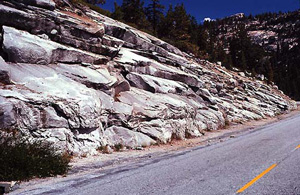 Rock
is broken into gently dipping plates by unloading joints. Unloading joints
probably form as the rock is exposed by erosion. These joints, and others
that are more steeply oriented, provide pathways for water to enter the
rock. Image is from Yosemite National Park in California. From
here.
Rock
is broken into gently dipping plates by unloading joints. Unloading joints
probably form as the rock is exposed by erosion. These joints, and others
that are more steeply oriented, provide pathways for water to enter the
rock. Image is from Yosemite National Park in California. From
here.