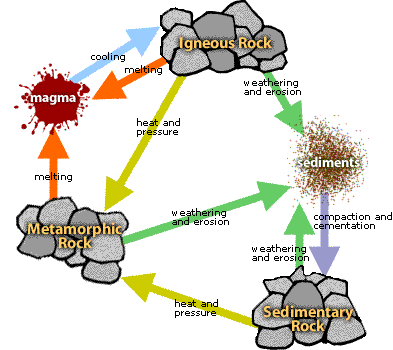
Notice how many time "weathering" and "erosion" (green arrows) appear in the above diagram?
NAVIGATION: BACK TO MODULE TWO INTRODUCTION
The Rock Cycle
(some content and the diagram below borrowed from NASA)
The rock cycle best explained as the relationship between earth�s internal and external processes. Weathering (breaking down rock) and erosion (transporting rock material) at or near the earth's surface breaks down rocks into small and smaller pieces. These smaller pieces of rock (such as sand, silt, or mud) can be deposited as sediments that, after hardening, or lithifying, become sedimentary rocks. Extreme pressure from burial, increasing temperature at depth, and a lot of time, can alter any rock type to form a metamorphic rock. If the newly formed metamorphic rock continues to heat, it can eventually melt and become molten (magma). When the molten rock cools it forms an igneous rock. Metamorphic rocks can form from either sedimentary or igneous rocks. The sedimentary particles from which a sedimentary rock is formed can be derived from a metamorphic, an igneous, or another sedimentary rock. All three rock types can be melted to form a magma. Thus, the cycle has continued over the ages, constantly forming new rocks, breaking those down in various ways, and forming still younger rocks. Rocks at the surface of the earth range in age from over three billion years old to a few hundred years old.
Igneous rock can change into sedimentary rock or into metamorphic rock. Sedimentary rock can change into metamorphic rock or into igneous rock. Metamorphic rock can change into igneous or sedimentary rock.
Igneous rock forms when magma cools and makes crystals. Magma is a hot liquid made of melted minerals. The minerals can form crystals when they cool. Igneous rock can form underground, where the magma cools slowly. Or, igneous rock can form above ground, where the magma cools quickly.
Notice how many time "weathering" and "erosion" (green
arrows) appear in the above diagram?
When it pours out on Earth's surface, magma is called lava. Yes, the same liquid rock matter that you see coming out of volcanoes.
On Earth's surface, wind and water can break rock into pieces (weathering!). They can also carry rock pieces to another place (erosion)!. Usually, the rock pieces, called sediments, drop from the wind or water to make a layer. The layer can be buried under other layers of sediments. After a long time the sediments can be cemented together to make sedimentary rock. In this way, igneous rock can become sedimentary rock.
All rock can be heated. But where does the heat come from? Inside Earth there is heat from pressure (push your hands together very hard and feel the heat). There is heat from friction (rub your hands together and feel the heat). There is also heat from radioactive decay (the process that gives us nuclear power plants that make electricity).
So, what does the heat do to the rock? It bakes the rock.
Baked rock does not melt, but it does change. It forms crystals. If it has crystals already, it forms larger crystals. Because this rock changes, it is called metamorphic. Remember that a caterpillar changes to become a butterfly. That change is called metamorphosis. Metamorphosis can occur in rock when they are heated to 300 to 700 degrees Celsius.
When Earth's tectonic plates move around, they produce heat. When they collide, they build mountains and metamorphose the rock.
The rock cycle continues. Mountains made of metamorphic rocks can be broken up and washed away by streams. New sediments from these mountains can make new sedimentary rock.
The rock cycle never stops.