|
|
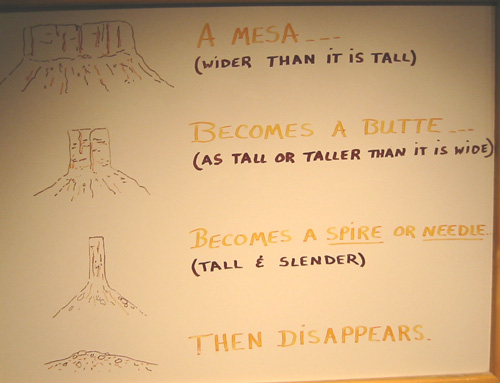
| Figure One. A picture of a dry erase board at a visitors center in Canyonlands National Park. Through time, a mesa evolves through different landforms and then, finally, disappears. |
NAVIGATION: BACK TO MODULE TWO INTRODUCTION
What Are the Themes for the Weathering Module?
The purpose of the first module (Module One, Tempe Butte) was to get you excited about geomorphology and to introduce you to landforms and basic geomorphic processes. Another concept from the Tempe Butte Module we wanted you to absorb is geomorphology "happens" everywhere, not just in a river bottom or cliff face or ocean beach. Even a mundane landscape, such as a flat river terrace surface (common in the Valley of the Sun) is affected by continual forces. The second module (Weathering), like the first one, examines the forces that work to shape landforms as well as examining the forms themselves. However, the general theme we try to follow that we hope will help you learn about rock weathering is landform change through time.
Theme One: Things Change:
A main goal of this module is for you to look into the landscape and not think of what you see as a permanent unchanging place... but rather, think of what you see as a "snapshot" in time from a long, always changing and always evolving process: we call this landform evolution. When you look at Tempe Butte or a mesa or a natural arch or a river terrace or a beach, imagine you have just hit the "pause" button on your VCR or DVD player to freeze the scene only temporarily. Remember, things change; landforms evolve through time (see Figure One).
|
|
| Figure One. A picture of a dry erase board at a visitors center in Canyonlands National Park. Through time, a mesa evolves through different landforms and then, finally, disappears. |
You have probably seen each of these landforms above before (a mesa, a butte, a spire, and a small hill). A small hill was a spire, a spire was a butte, a butte was a mesa. The point of this illustration is to recognize that things change; things evolve. A theme of this lab is landform evolution, that is, how does a scarp (cliff) change through time? How does a steep cliff face evolve to a talus or scree and then into soil? How does a sandstone fin evolve into a arch? How does a river meander form a natural bridge? How does a gnamma (weathering pit) eventually drain its water in its sequence of evolution? As in Figure One above, this module attempts to unravel the processes that cause a mesa to be transformed to a small hill (the "disappears" phase of Figure One above).
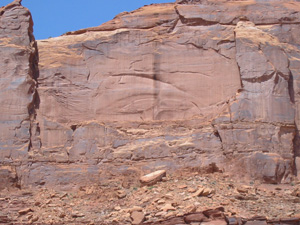
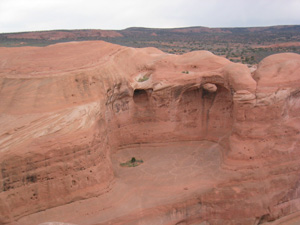
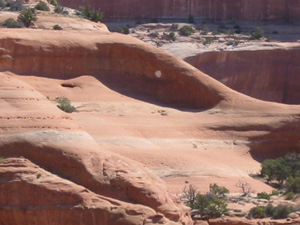
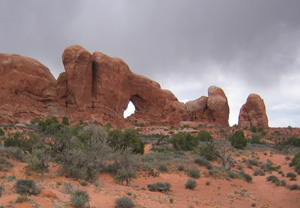
Figure Two below shows four "snapshots" (when you hit the pause button) from a hypothetical geologic-time DVD - video taken of the same location over the course of thousands of years. Again, realizing that landscapes look differently at different stages of evolution is a theme of this module.
|
|
|
|
Stage Three - A tiny "window" appears! Weathering happens... |
Stage Four - An arch forms! Weathering happens... |
| Figure Two. Landform evolution. Do you think Stage One (cliff) will eventually become Stage Four (arch)? | |
Theme Two: Process/Form and Form/Process:
An important concept in geomorphology is the interaction between "process" and "form". For example, if you are studying sand dunes (form), you would probably study the wind (process) that shapes the dunes. Similarly, if you are studying historical building or statue or monument preservation (form), you would probably study weathering (processes) responsible for deteriorating the monuments: If you are studying paleo-climate (process), you would probably study ice cores. Get the picture? We find many clues in the landscape, whether current processes or remnant forms, that help us understand landscape evolution. Keep this interaction in mind throughout the remainder of the course!
Why are we lucky to have an arid backyard?
Consider yourself lucky - the Phoenix area (and most of the Colorado Plateau - the destination for this module) is a favorable location to study rocks � there is little vegetation to obscure our view of rocks. You witnessed this first hand in the first module (Tempe Butte) -- there was not much vegetation to obscure your view of the Butte's surface!
PS: Here's a GREAT Website with LOTS of information on Utah geology. Here another one!