NAVIGATION: BACK TO INTRODUCTIONJohn Wesley Powell (1834-1902) and Antecedence proposed 1875:
John Wesley Powell is a legend. He grew up in Wisconsin--a farm boy, doing most of the work while his father put together sermons for his Methodist church. But Powell never found much satisfaction with a farmer's life, and trained and educated to become a teacher. He taught for several years before enlisting in the Army as the Civil War was getting underway. As a firm abolitionist, he felt it was his duty to fight in a war to end slavery. During the war, he acquired the rank of Major (a title commonly used by friends) but lost the lower portion of his right arm. Losing an appendage, an the ongoing pain associated with the related several surgeries plagued him till the day he died. Many folks would likely have struggled to attain even modest goals for themselves, but not Powell. After the war, he went back to teaching. A job his father said was about the only option for a crippled man. He received a post teaching at an Illinois University, and it was there he began to set into motion the events that propelled his career.
Figure 2. John Wesley Powell in his office and drawings from the Powell Expedition down the Colorado River in 1869.
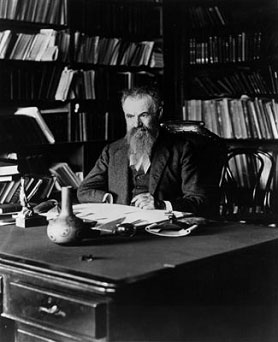
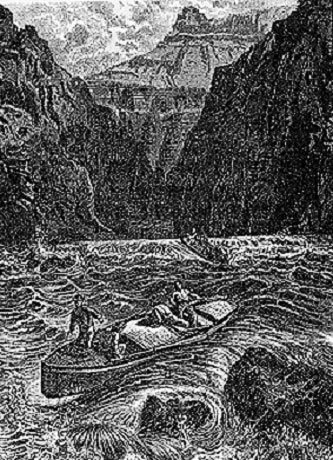
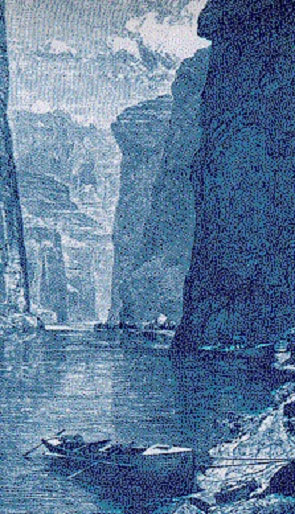
Powell struggled with university hallways where he simply talked about his passion (mostly geology at the time), while never actually doing anything out in the field. Like many of his contemporaries, he felt drawn to the west where so much seemed possible. So like any good professor, he gathered a bunch of students together and headed off to Colorado in 1868. On their trip, they explored the Colorado River's headwaters along the crest of the Rocky Mountains. He and his students traveled country never before visited by scientists, made numerous first ascents of prominent mountains (including Longs Peak), and spent time with native people while they still practiced traditional customs. Our class and the virtual field trips (and optional field trips) are a far cry from their Colorado Rockies expedition, but I guess we all stay warm and well fed J. While on this trip, Powell got a crazy idea in his head (even more so for a guy with one arm). He wanted to lead an exploratory float trip down the Colorado River from Green River, Wyoming to the Utah settlements just north of what is today Lake Mead. Major Powell intended to finish what Newberry and Ives started--an investigative journey along the Colorado River corridor. In 1869, he completed his infamous expedition. Doing so he filled in the only remaining unknown gap in the contiguous United States, and did it with a ragtag assembly of eight fellow war veterans and mountain men.
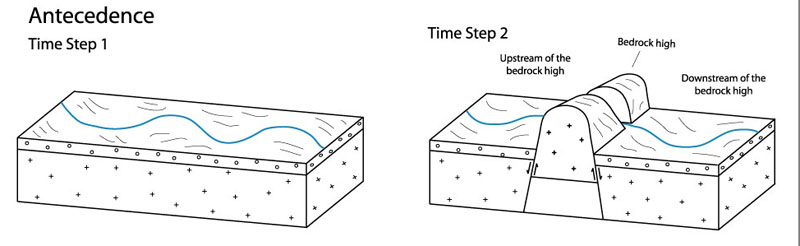
Numerous books discuss this historic expedition in more detail, so if you're interested check them out. "A River Running West" by Donald Worster focuses more on Powell as a person and a great read. Back to the topic at hand, its on this historic river trip that Powell hypotheses his famous explanation for Grand Canyon incision. His idea is very straightforward and makes intuitive sense to a lot of people. Its called antecedence. Here's how it works:
1) The Colorado River flows across the Grand Canyon region pretty much as it does today, except no canyon and no Kaibab Plateau.
2) The Kaibab Plateau begins to uplift beneath the river.
3) As the plateau slowly uplifts, the Colorado River's bed becomes sharply steeper along the Kaibab Plateau's downstream or eastern flank. The steeper river provides the impetus for the river to cut into its bed. If the river erodes faster than the plateau uplifts, the river maintains its path while eroding a canyon into the rising structure.Still doesn't make sense? Try this. Imagine a stick of butter resting on a plate. Now visualize a knife with the sharp edge resting lightly on top. The butter represents the Kaibab Plateau and the knife represents the Colorado River. Finally, picture the stick of butter being pushed upward while the knife stays in place. You just as easily move the butter up, as you can push the knife down. The effect is the same, not unlike a river and a rising mountain.
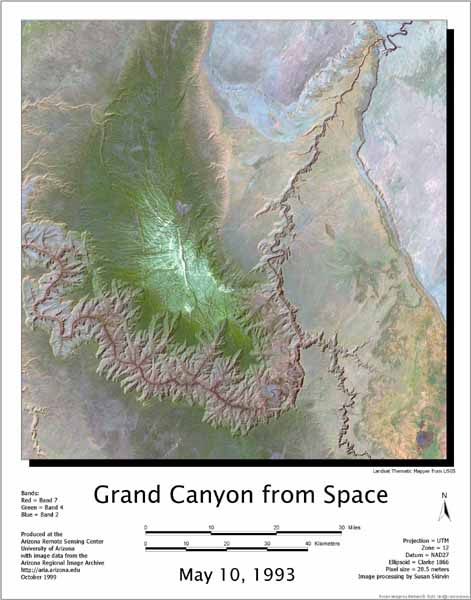
Figure 3. An image of the Kaibab Plateau (big green thing) in relation to the Colorado River.
For antecedence to work, the Colorado River needed to flow roughly where it does today before the Kaibab Plateau uplifted. In other words, the Colorado River needs to be older than the Kaibab Plateau. In the 1930s, geologists called this criteria into question after scrambling all over the future site of Lake Mead and Hoover Dam. Two of these prominent geologists, Eliot Blackwelder and Charles Longwell, uncovered evidence that plagued the antecedence hypothesis ever since.