NAVIGATION: BACK TO MODULE SIX INTRODUCTION
A Review of the Four Mechanisms and Recent Colorado River Activity
The chart below is a quick overview of the different mechanisms:
Author
Hypothesis
Year
Newberry, J.S.
Lake-Overflow - A large lake behind the Kaibab Plateau, filled to capacity and overspilled into the lower Lake Mead region. The Bidahochi Formation in northern Arizona provides important evidence of this lake. The released water eroded into the western flank of the Kaibab Plateau, eventually undermining the lake-outlet, which led to a large release of lake water that initiating Grand Canyon incision.
1861
Powell, J.W.
Antecedence - The Colorado River flows pretty much how it does today, out of the Colorado Rockies to the Gulf of California. Over time, the Kaibab Plateau begins to uplift beneath the Colorado River's course from compressional stresses. As the Kaibab Plateau uplifts, the Colorado River entrenches itself into the rising plateau.
1875
Blackwelder, E.
Lake-Overflow - Same as Newberry's hypothesis, but additional evidence counters the antecedence hypothesis. The Colorado River bisects the Muddy Creek Formation in the Lake Mead region, and for this to happen, the Colorado River must be younger than the Muddy Creek Formation dated at 16 to 6 million years old. The Kaibab Plateau uplifted between 70 and 40 million years ago, and the Colorado River must be older than the Kaibab Plateau for antecedence to work.
1934
Strahler, A.
Superimposition - As scarps retreated off the Kaibab Plateau, the plateau became buried in debris, making a sediment ramp for the Colorado River to flow across the Kaibab Plateau. A scarp retreating off the southern flank of the Kaibab Plateau controlled the southward bend of the Colorado River across the Kaibab Plateau. Superimposition accounts for the "Muddy Creek" problem because the Kaibab Plateau existed, although buried, before the Colorado River flowed across the sediment ramp to the Lake Mead region.
1948
McKee, E.
Stream Piracy - The "old" Colorado River flowed east of the Kaiab Plateau out of the Rocky Mountains and drained into Lake Bidahochi. The Hualipai Drainage developed west of the Kaibab Plateau. Because of Colorado Plateau uplift and the opening of the Gulf of California, the Hualiapai Drainage eroded headward into its headwaters west of the Kaibab Plateau. Eventually, the Hualipai Drainage erodes across the Kaibab Plateau and captures the Colorado River, establishing its present course.
1964
Now what? Well real quick, I should tell you about Ivo Lucchitta, a great writer and geologist who proposed his own take on the events that lead to the Grand Canyon. His ideas were published in the book "Grand Canyon Geology" in 1990. His idea combined Strahler's superimposition and McKee's stream piracy. Lucchitta proposed the Colorado River crossed the Kaibab Plateau via superimposition. But instead of heading towards Lake Mead, the river headed northwestward toward southwestern Utah along the Kanab Creek drainage. While the river flowed along the path of Kanab Creek, the Hualipai Drainage eroded headward from the Lake Mead region and captured the Colorado River via stream piracy west of the Kaibab Plateau. The newest component of Lucchitta's hypothesis has a major problem, there is little evidence the Colorado River ever flowed northward along the path of Kanab Creek. So it seems as we get closer to the present, hypotheses get more complicated with more complicating problems. You will soon go on the virtual field trip and look at the evidence yourselves, and you can make up your own mind.
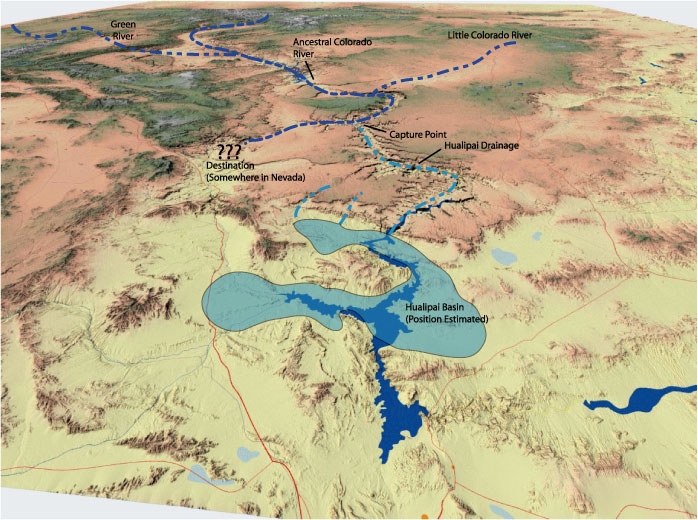
Figure 1. A schematic that illustrates Lucchitta's hypothesis for Grand Canyon development.
Today we think Grand Canyon initially began to cut about 5 to 6 million years ago. Although, a recent paper calls this into question, and it may be much older click here. But a lot can happen in 5 to 6 million years. It turns out that only the upper part of the Grand Canyon was initially cut about 5 to 6 million years ago, leaving the bottom half, some 2,500 feet (in eastern Grand Canyon), left to cut before reaching its present depth. The the data indicates this second phase of incision started between 2 and 1 million years ago and still remains a problem.